| 12/15/2025: Indianalysis [RightDataUSA] | ||||||||||||||||||||||||||||||||||||||||||||||||||||||||||||||||||||||||||||||||||||||||||||||||||||||||||||||
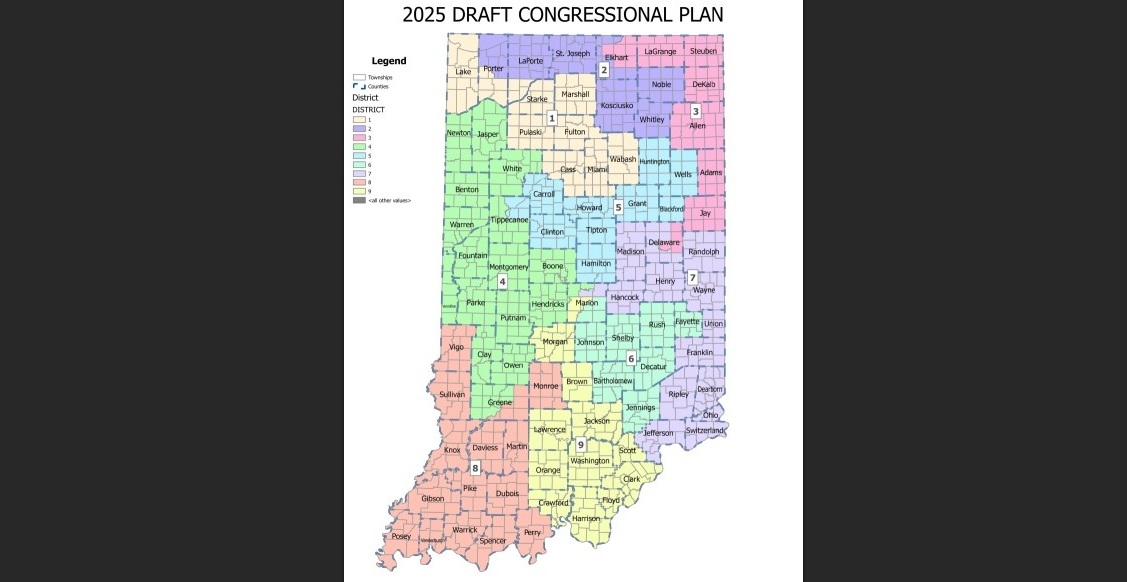
On October 27, one week before the state of California was inevitably going to approve its most recent Democrat gerrymander (it passed by 3,000,000 votes and will cost Republicans 4 or 5 House seats), Indiana Governor Mike Braun called for a special session of his state's legislature in order to retaliate against California to some degree. There's only so much that a relatively small state such as Indiana can do against a behemoth like California, but Braun and Indiana conservatives -- encouraged by President Donald Trump -- prepared to revise the Hoosier State's congressional district map in such a way as to enable Republicans to go from a 7-2 advantage in the Indiana delegation to possibly as much as a 9-0 sweep in a good election year.
Background: Republicans already hold 7 of Indiana's 9 U.S. House seats, and have been in control by that exact margin since the 2012 election. The two districts which they perennially do not hold are CD-1 in the northwestern part of the state, and CD-7 which is most of the city of Indianapolis. The purpose of the new map was to alter these two districts sufficiently to favor Republican candidates in 2026, and to do so without endangering Republican incumbents in the other 7 districts. That is what California Democrats accomplished with their new gerrymander which eliminates 4 or 5 House Republicans while simultaneously protecting half a dozen Democrats who could be vulnerable to a minor "red" wave. Indiana Congressional District 1 (CD-1): 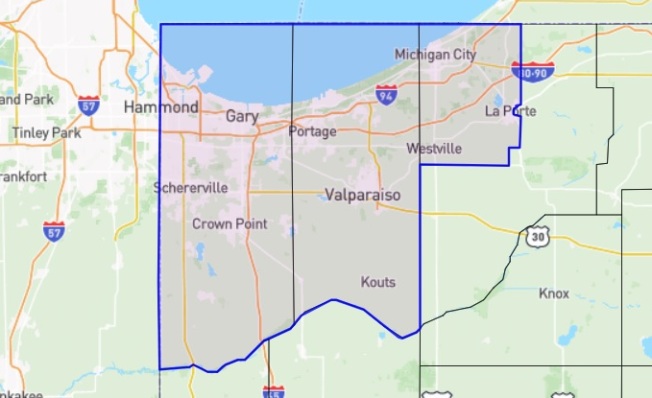
Indiana Congressional District 1
CD-1 has been in Democrat hands for almost 100 years without interruption; no Republican has ever won a House race there since the district was created in 1932. At that time Lake County (Gary, Hammond) was given its own congressional district, the rapidly growing county having gone from 38,000 residents in 1900 to a population of 261,000 by 1930. Since then, CD-1 has always contained most or all of Lake County, but in recent years Porter County and parts of LaPorte County have been added. Lake County has been losing population since the late 1960's, when Whites began fleeing in droves -- leaving behind a county and congressional district which thus became even more Democrat-oriented.
CD-1 has become much more competitive recently, and the GOP realizes that even a fairly small shift to the right could result in an unprecedented House win there; the new map for 2026 was going to implement that small shift to the right. In 2020, frequent (and hopeless) Republican candidate Mark Leyva received slightly over 40% of the House vote against Democrat Frank Mrvan. Donald Trump did even better than Leyva in CD-1 that year, taking a shade under 45%. That may not sound impressive, but it represented a vast improvement in GOP fortunes in northwestern Indiana. In 2022 Republicans took a serious shot at unseating Mrvan by nominating (and funding) Jennifer-Ruth Green, an Air Force veteran and commercial pilot. Green claimed to be a conservative but foolishly distanced herself from Donald Trump and took liberal positions on some issues; she lost by about 5 points. In 2024 Mrvan was opposed by state Senator Randy Niemeyer, a moderate/establishment Republican. But this time the GOP was not interested in wasting millions of dollars that it couldn't afford, and the party did not support Niemeyer as well as it had Green. Niemeyer lost by 8.5% -- which is still much better than Republicans had historically done in CD-1. Trump in 2024 lost by less than 1% against Kamala Harris in CD-1, a margin of barely 1,000 votes out of 327,000. Mrvan knows that his House seat is not perfectly safe by any means. He had been running a little scared in 2025, but can breathe easier now that Indiana Senate RINOs have protected him. The district is rated by Charlie Cook as being D+1, but others who rate districts based on a larger dataset have it more like D+4. The proposed district map for 2026 would have made it R+1 according to the limited (and possibly specious) data which is available. In a good Republican year (in other words, probably not 2026), Republicans would have a decent chance of picking up this House seat even under the current boundaries of the district. Had the new map been passed, they would not have required quite as much of a "good" year to snatch CD-1 from the Democrats for the first time ever. Indiana Congressional District 7 (CD-7): 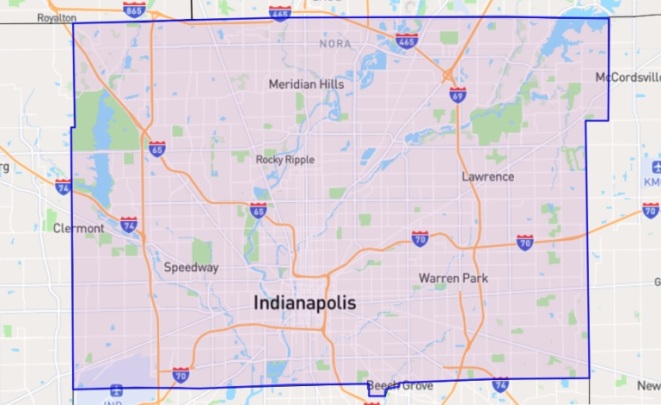
Indiana Congressional District 7
This district, which was the old CD-10 until Indiana was reduced to 9 districts in 2002, was only slightly D-leaning in the 1990s. Republicans made a concerted effort in 1996 when Andy Jacobs retired. Jacobs, a Democrat who was first elected in 1964, was known for spending practically zilch on his campaigns yet he still prevailed time after time; Democrats had to spend nearly $600K to hold the seat in '96.
2025 Redistricting Attempt: As mentioned above, the new map which would have resulted in a minimum of +1 House seat for Republicans was rejected by the Indiana state Senate by a vote of 19-31. Twenty-one RINOs joined all 10 Democrats in saving one or perhaps two Democrat seats in Congress. Here is some more information about the 21 traitors, 10 of whom are up for re-election in 2026; the other 11 will not have to face the voters again until 2028.
Probably not coincidentally, the vast majority of the GOP quislings occupy Senate seats which are in the vicinity of the two U.S. House districts that could have flipped from D to R had these quislings' votes not put an end to that possibility. Of the 21, only two (Dernulc, K. Walker) represent Senate districts which could be described as marginal in a normal election year; the other 19 are varying degrees of safe for the GOP nominee.
Despite all that, the 21 virtuous cowards are being generally defiant about their surrender. As is customary with RINOs, they cower like whipped pups in the face of the media and other Democrats, and save what little courage they possess to use only when opposing true conservatives in their own party. On December 11 several of them raced to the media to issue statements defending their backstabbing of Republicans nationwide:
"Thousands". "Overwhelmingly". Sure. Several of these folks are going to hear from thousands of voters in next year's primary election, and will hopefully be overwhelmingly rebuked at the polls. Bray, Doriot and Leising are exempt, what with not being up for re-election until 2028; Bray may still receive some punishment after 2026 -- he may find himself as "Minority Leader" or find that his majority is greatly reduced. Some Twitter account posted this on the day of the Indiana vote:
Yes it's just an unproven conspiracy theory, but it fits with the general idiocy of the Stupid Party. Not only did Indiana Republicans surrender when they were winning, but it figures they would do so under terms which are totally unfavorable -- allowing Democrats to retain two seats in the Hoosier State while maybe retaining one GOP seat in Maryland. 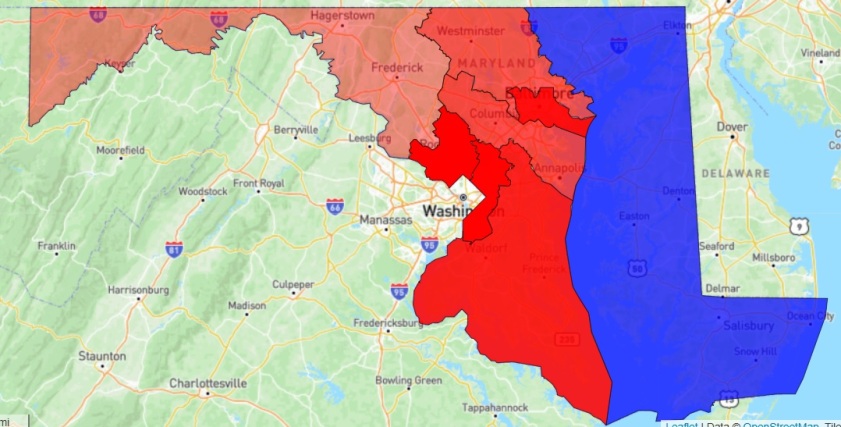
Maryland 2024 House results: 1 R, 7 D
The Democrat president of the Maryland state Senate had already announced that gerrymandering would not be on the agenda during the special session which has been called for mid-December, despite pressure from Maryland Governor Barack Obama 2.0 (a clean and articulate empty suit, who for years has been carefully groomed in preparation for achieving high political office). Additionally, a Democrat gerrymandering expert has warned that an attempt to create an 8-0 sweep of the Maryland congressional delegation would likely not withstand a court challenge, assuming the sleepy, complacent GOP would choose to file a challenge.
Gerrymandering War scorecard: Here is how things currently stand: 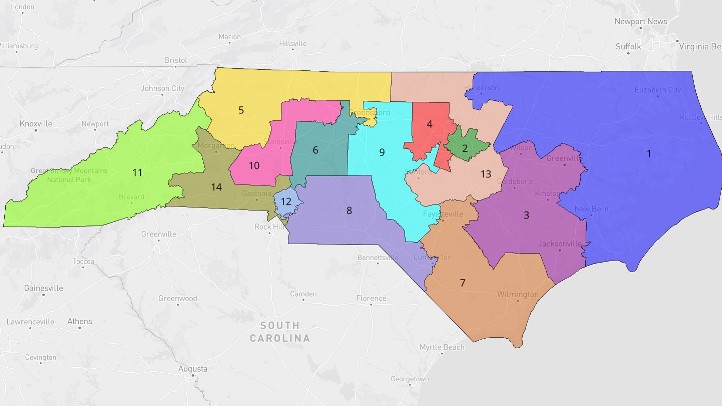
Map source: Dave's Redistricting
In North Carolina, a panel of federal judges dismissed Democrat claims of "racism" and refused to order the injunction which the professional racists sought. This presumably means that the new congressional district map drawn by the Republican legislature will be used for the 2026 midterms. Republicans currently hold a 10-4 advantage in the North Carolina delegation, the new map makes only minor changes, and those changes primarily affect only two districts (CD-1 and CD-3). CD-1, which is held at this time by Democrat Don Davis, is being changed from a PVI of D+1 to perhaps R+3. This could be enough to dislodge Davis, assuming 2026 isn't a "blue" wave of any kind. The adjacent CD-3 moves from R+8 to R+3. As we have noted many times, most of the 10 GOP-held districts are marginal to some degree, and in a bad election year we could see a real bloodbath in the Tarheel State. Having an uninspiring simp like Michael Whatley lose big to Roy Cooper in the Senate race is not going to help matters down the ballot.
Map source: Dave's Redistricting
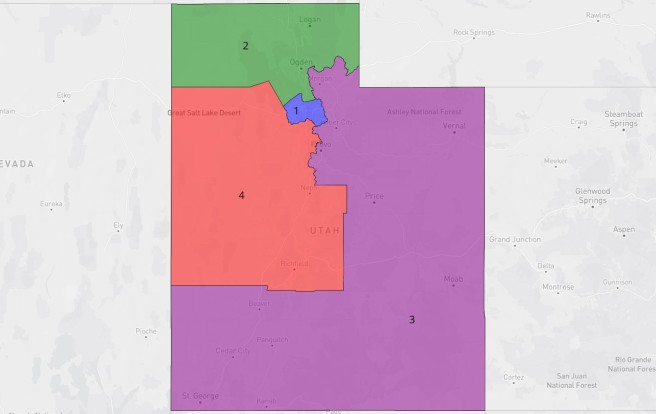
In extremely Republican Utah, a RINO judge has sided with Democrats and is forcing the state to discard the district map which was used in 2022 and 2024 (which resulted in the GOP winning all 4 House seats). Initially, she was expected to select a new map which would have two super-safe Republican districts and two iffy ones, both of which tilted a little to the right. Instead she chose a map which would guarantee one Democrat pickup. Therefore, at best, the supposed GOP win in North Carolina is negated by the certain loss in Utah.

Map source: Dave's Redistricting
On December 4, the U.S. Supreme Court in a 6-3 decision granted an "emergency stay" which allows the new Republican-drawn map in Texas to be used in 2026 while Democrat lawsuits continue indefinitely. As a result of the stay, Republicans expect to pick up as many as 5 U.S. House seats which are currently held by Democrats. The affected districts are:
Map source: Dave's Redistricting
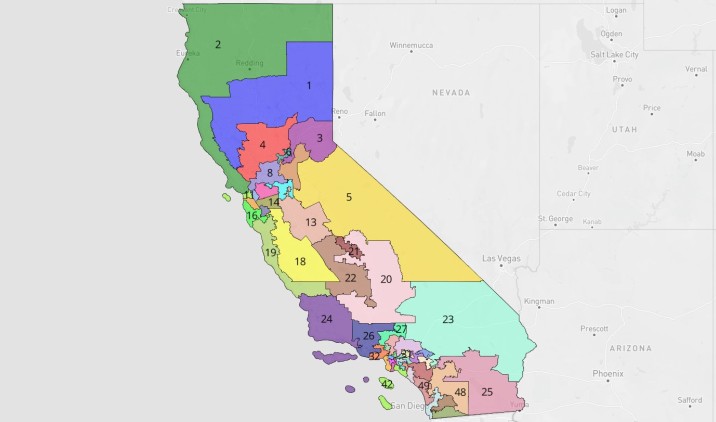
California voters in November passed Proposition 50, which allows the state to proceed with its hyper-partisan gerrymander which is designed to eliminate 5 Republicans from the California delegation in the U.S. House. Using the same tactic which Democrats have relied on (with much success) over the past 30+ years, the U.S. Department of Justice has joined California Republicans who are suing California on the basis that the new map mandates racially-gerrymandered districts, which is illegal. The motion to intervene is still pending before a U.S. District Court in California. Don't hold your breath in anticipation of any relief here. The case was scheduled to be heard on December 15. Another Republican lawsuit has already been dismissed for the good, old "lack of standing" reason that liberal judges often use against Republicans who have a good case (remember 2020?).
Map source: Dave's Redistricting
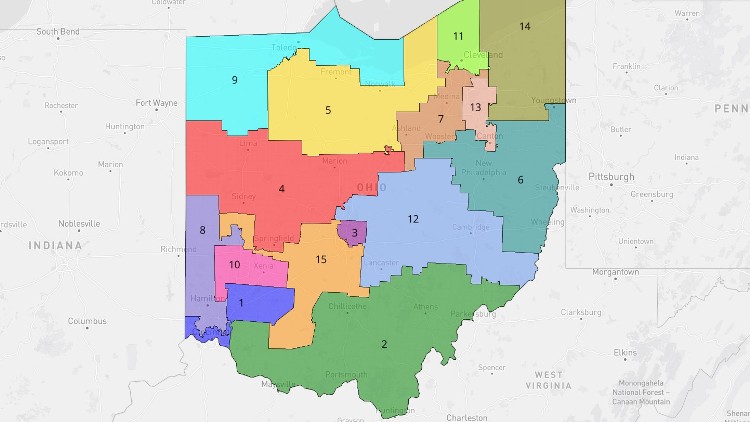
There will be a new congressional district map in Ohio for 2026, but it is not substantially different from the map which was used in 2022 and 2024. A revised map was required by state law because the previous one was passed without bipartisan support and was therefore only permitted to be used twice. The 2026 map does have bipartisan support, which ought to tell you something about how effective it will be for Republicans in 2026 and beyond. The GOP currently holds 10 of the 15 U.S. House seats in Ohio, but three Democrat-held districts (CD-1, CD-9, CD-13) are shaky at best. Yet Republicans failed to capture any of the three in 2022 or 2024. They will give it another try in 2026 under district boundaries which have received only subtle alterations from those which existed in the past two elections. CD-1 and CD-9 are moved imperceptibly to the right, while CD-13 goes the opposite direction in a similarly negligible way. There are some shaky GOP-held districts too, so if 2026 goes sour there could be a few House results in Ohio which would surprise the unaware. 
Map source: Dave's Redistricting
The redistricting effects of Texas (R) and California (D) will cancel each other out, or come close to doing so; North Carolina (R) and Utah (D) also may be a net-zero. Ohio will likely end up with a 10-5 GOP advantage, no change from the current situation. Missouri's revised 5th Congressional District is going to be about R+8, an easy GOP pickup from the existing Democrat in CD-5. That makes the current aggregate redistricting score probably +1 for the GOP in 2026, with some variation depending on the overall demeanor of the election. If there is some "blue" wave, which should be greatly expected as things stand now, then any minor redistricting advantage accruing to the Republicans would be swamped by a general swing to the left overall.
Tags:
Indiana
U.S. House
Surrender RINOs
|