| 12/3/2025: Tennessee Special Election: Post-Mortem [RightDataUSA] | ||||||||||||||||||||||||||||||||||||||||||||||||||||||||||||||||||

Democrats were counting on Santa coming early to Tennessee this year.

Photo credit: Tennessee Star
Van Epps' win was quite an important result, given the narrow GOP margin in the House, and the amount by which he triumphed is not nearly as important though it will be the subject of rigorous analysis in the media for the next few days before being forgotten.
We have already highlighted much of the Tennessee Democrat's nutzoid viewpoints here, but of course few if any of those things were featured in Aftyn Behn's campaign ads. Instead, those ads focused on the economy, health care, and of course hating on Donald Trump and Republicans. Behn campaigned as a populist rather than as the woke lunatic she really is. She didn't fool quite enough voters, but she did make a dent in the customary Republican MOV in TN-7. DNC chair Ken Martin called Behn's performance "historic", and "a flashing warning sign for Republicans heading into the midterms". Behn hinted that she may run again for Congress in 2026 (please do!), but Democrats are probably not quite so stupid as to allow that. Will anyone admit she was a bad candidate, or at least that she was just an experiment to see how a complete left-wingnut would fare in a low-turnout special election in a supposedly "deep red" district? Will they really stick to this approach going forward? A Democrat who is less radical than Behn would undoubtedly have fared better on Tuesday. In the end, what we have here is yet another "moral victory" for Democrats to go with the actual victory for Republicans. The same thing happened 8 months ago in a couple of special elections in Florida, with Republicans winning and retaining those seats -- but they won by only half as much as they were "supposed" to. Democrats spent an inordinate amount of money trying to purchase an actual "solid red" district (FL-6), but they failed miserably there too. Because Republican Randy Fine won that election by only 14 points instead of 28 points in the R+14 district, Democrats were outwardly cheerful then too despite losing by over 25,000 votes. Today's talking points regarding this tremendous Democrat victory (LOL) on Tuesday:
There is at least one kernel of truth contained within all the spinning, and that is point number two. For example, the recent re-map in North Carolina may help pick up one (1) seat for the GOP in 2026, however at least half a dozen Republican incumbents are endangered in the Tarheel State; the Republicans are still favored in their respective districts but in a "blue" wave a lot of them could drown. Meanwhile in California, the recently-approved Democrat gerrymander not only eliminates 4 or 5 GOP House seats, but also protects half a dozen Democrat incumbents who may have been vulnerable without the new map. When Republicans get into a gerrymandering war with the experts at such things -- Democrats -- they may find themselves outclassed even if the courts actually permit the new GOP maps to be used. 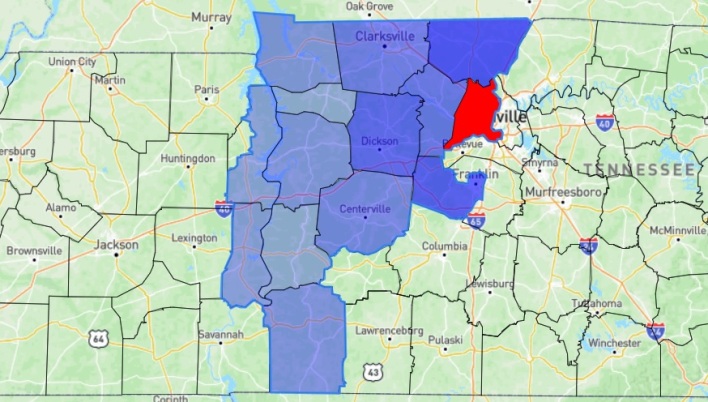
TN-7 results: December, 2025 special election
Election report card:
Montgomery County was disappointing for Van Epps, but the ones other than Nashville saved him. We said, regarding the 2024 House election: "In the other 12 counties combined, Green took over 72%. Van Epps had better get 65% or more, even if he can't quite muster 72%". He got 68.7% in the 12 counties outside of Davidson & MontCo. Generally, the farther away a county is from Nashville, the less it swung to the left on Tuesday (Robertson being an exception; it is adjacent to Nashville but did relatively well for Van Epps anyway). We asked: "Does 54.3% of the 2025 primary vote going to the GOP mean anything for the general election? If so, it probably just sets an upper limit for Van Epps". He took 53.9% as it stands now, very close to that theoretical limit. The relative party vote shares in primary elections in House races rarely forecast general elections with such precision as we saw in TN-7 in both 2024 and 2025. Turnout was certainly a factor, with the early/absentee ballots (which always favor the left) being insufficient to get the Democrat over the hump. We said: "Even with visions of 2018 dancing in Democrat heads, it's possible that turnout next week will not reach that 2022 number (181,000). . . and low pre-election day turnout here -- if it stays low -- may actually favor Republicans". Turnout in 2025 was 180,000 with still a tiny number of votes possibly remaining to be counted. Rats needed a repeat of 2018 as far as motivation was concerned; instead they got a repeat of 2022. That wasn't bad at all for a special election, but not nearly enough to tip the scales. We also predicted a Van Epps win "by 2 or 3 points". His MOV was 8.9% and that, under the circumstances, is a significant accomplishment even if it's not anywhere close to the 16% GOP lean of the district. Democrat money, motivation and organization had a big impact (as they always do in low-turnout special elections), but those things didn't make a big enough impact because Republican voter turnout on Election Day dwarfed that of the Democrats'. As we have noted above, the outcome in TN-7 was quite similar to the special election in FL-6 in April -- with the GOP winning, but only by half the normal amount. As in FL-6, although they invested heavily in the special election and claimed a moral victory, Democrats will not be spending quite so outrageously in 2026 in solid "red" districts, so Van Epps should be safe in TN-7 (except perhaps in a primary) from this point through at least 2030. One final word about this district: of the 435 House districts nationwide there are 212 which lean R; 5 are rated even; and 218 lean D, not factoring in any of the 2025 redistrictings yet. TN-7 is rated as R+8, which ranks it only as the 139th most Republican district in the country (tied with 12 others). Even if you accept Charlie Cook's rating of R+10 instead of our R+8, that would rank TN-7 121st at best. In either case, that's a curious definition of "dark red". It's just ordinary red, that's all. But the media and other Democrats are obliged to make it sound to their unenlightened followers as if the greatest upset in election history almost occurred here. Tags:
2025
Tennessee
Special election
Merry Christmas!
| ||||||||||||||||||||||||||||||||||||||||||||||||||||||||||||||||||
| 11/27/2025: Tennessee Special Election: Do Republicans Need Another Wake-up Call Already? [RightDataUSA] | ||||||||||||||||||||||||||||||||||||||||||||||||||||||||||||||||||

Photo credit: The Tennessee Conservative
On December 2 there will be a special election in Tennessee's 7th Congressional District to fill the vacancy which was caused when Republican Mark Green resigned from the House in July to "take a job in the private sector". The GOP currently controls the House by the count of 219-213. There are two vacant Democrat seats (TX-18, NJ-11) which will be easily retained by other Democrats when the special elections for those seats roll around next year. The outcome of this Tennessee election next week will determine whether the Republican advantage is eventually 5 seats (220-215) or 3 seats (219-216).
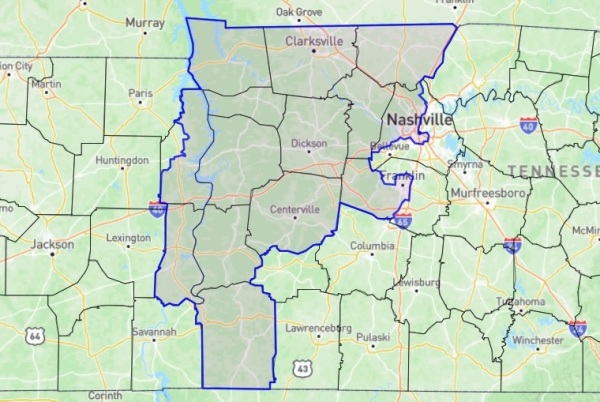
Current map of Tennessee congressional district 7
In 2021 Tennessee Republican redistricters did something that their colleagues in other states were too chicken to do. They broke up a Democrat district (CD-5) which caused Republicans to pick up one House seat as of 2022. CD-5 formerly contained all of the city of Nashville, and therefore was heavily Democrat. But for 2022 and beyond the city was split into three pieces, and those pieces were attached to heavily Republican suburban and rural territory. CD-5 incumbent Democrat Jim Cooper saw what he would be up against in 2022, and opted to retire.
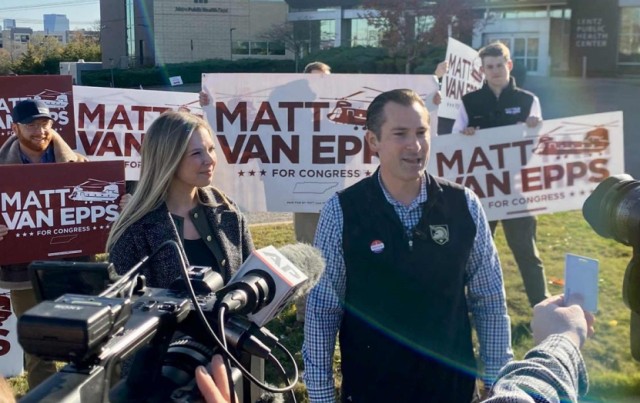
Photo credit: Nashville Tennesseean
GOP nominee Matt Van Epps is a West Point graduate, U.S. Army veteran and current member of the Tennessee Army National Guard. He is a former official in the administration of Tennessee Governor Bill Lee, most recently as director of the state's Department of General Services. Van Epps previously served as Lee's "COVID Czar", which is not exactly a resume-enhancer. Van Epps, like Lee, is considered by many to be a member in good standing of the squishy GOP establishment. There was an 11-way Republican primary in October, which was decisively won by Van Epps after he received the endorsement of President Trump, much to the dismay of conservatives.

Photo credit: Tennessee Star
His opponent, radical leftist Aftyn Behn, could hardly provide a more stark contrast.
Any one of the above would make a great campaign ad for Republicans. But are they on the air with any of this? Or are they just making a few posts on Twitter? Polling and other data: A new Emerson poll as of 11/26 shows Van Epps up but a very close race. Why should we trust anything Emerson says? Look at their forecast of the New Jersey Governor election -- they had the Republican losing by just 1 point. Just because they were delighted to be wrong about the extent of Jack Ciattarelli's defeat, doesn't make them any less wrong. Some observers have noticed what appears to be an oddity in the internal breakdowns of yesterday's Emerson poll. Trump won Tennessee's 7th Congressional District with 60.4% of the vote in 2024. Yet Emerson has only 53.6% of their polling sample as being Trump voters. We concede that turnout and motivation are much different now than they were in 2024; to slightly modify a common phrase which is popular among losers: "12 months ago is an eternity in politics". But have things really moved 7 points to the left in CD-7? Haven't we been assured by the GOP establishment and other deniers of reality that everything bad which happened three weeks ago was confined to "blue" states only? So it can't happen here -- or can it? As far as financial data, the latest FEC reports on this election are from two weeks ago. At that time the Democrat had raised about 25% more money than the Republican (what else is new?) but had spent slightly less. Even based on those somewhat out-of-date figures, Behn had about $300,000 more cash-on-hand than Van Epps did, heading into the final 3 weeks of the campaign. You can be reasonably certain that in those final 3 weeks, the Democrats have raked in, and will spend, far more than the Republican. That fact will be apparent when the final FEC reports become available. 
Photo credit: Drill Down with Peter Schweitzer
Nearly all of the $1.2 million which Behn has raised allegedly comes from "individual" contributors. The Democrats' ActBlue Laundromat routinely splits billionaire donations into tiny fragments and assigns those fragments to unaware individuals in a process known as "smurfing". This creates the illusion of broad "mom-'n-pop" support (not to mention evading campaign finance laws) and allows the Democrat to declare with a straight face that she is a candidate "of the little people". Van Epps, on the other hand, must rely on actual individual contributions, and those have been insufficient to be competitive in a high-stakes race like this one. To bridge the fundraising gap, the Republican has had to take a substantial amount (about 30% of his receipts) from PACs.
In 2024 Mark Green won 13 of the 7th District's 14 counties, losing Davidson County (Nashville) by 26,000 votes but winning overall by 69,000 votes. Nashville gets all of the hype in the district but cast only 22.3% of the vote in 2024. The city will give Behn a substantial majority next Tuesday; Nashville voters hate Republicans more than the Democrat nominee hates Nashville. It's a complex relationship, LOL. Montgomery County, with 24.1% of the vote, is the top vote-producer in the district and carries a little more weight than Nashville. Green won Montgomery by 19.7% in 2024; Van Epps will not approach that number. In the other 12 counties combined, Green took over 72%. Van Epps had better get 65% or more, even if he can't quite muster 72%. So how do all those figures from just 12 months ago suddenly translate into a very close race now? They shouldn't. Green's performance last year was not an anomaly: even though the Democrats fielded a candidate who was a felon (but a cute one!), you can't say they didn't try to win in 2024; they spent $1.25 million, more than they spent in the other two Nashville-area districts combined. Even though Republican Andy Ogles in CD-5 was declared by the media to be vulnerable, the Democrats mostly bypassed Ogles and focused more resources on opposing Mark Green instead. Ogles won by nearly 20% in CD-5, almost the same MOV that Green attained in CD-7. Primary data: There were 53,483 total votes in the 2024 House primaries in CD-7, 59.6% of which went to the unopposed GOP candidate. Green then got 59.5% in the general (some little-known independent took 2.4%). It was just a coincidence that the primary vote share was so close to Green's general election percentage, but not a complete coincidence. There were 67,886 total votes in the 2025 special election primaries, 54.3% of which went to Republicans. Democrats are seizing upon this data point, claiming it is an indicator of a substantial shift in their direction. However, the fragmented Rat primary and Behn's lack of endorsement by the primary losers could indicate an upcoming underperformance for her in December. It's a nice thought, but don't bank on it happening. The Republican primary was just as split as the Democrats', and the wounds inflicted there have not healed. On the Democrat side, money makes up for a lot of hurt feelings. Does 54.3% of the 2025 primary vote going to the GOP mean anything for the general election? If so, it probably just sets an upper limit for Van Epps. There will be 4 independent candidates on the ballot, one of which is a former Republican. Altogether they will take 2 or 3 percent of the vote at most. Conclusion: All pertinent factors indicate a close race (within 5 points one way or the other). No factors indicate an easy GOP win. The factor which favors the Republicans to the greatest degree is the most irrelevant one of them all -- the PVI. PVIs are created based on regularly-scheduled elections with high turnout, and 2025 is not going to be one of those. There were 323,000 votes cast in CD-7 in the presidential year of 2024; turnout was 181,000 in midterm 2022, but it was a little over 250,000 in 2018 (the last midterm in which Democrats were motivated by as much hatred as they now possess). Even with visions of 2018 dancing in Democrat heads, it's possible that turnout next week will not reach that 2022 number. As of 11/26, 84,000 votes had been cast either early or absentee. That doesn't sound like much to us, and low pre-election day turnout here -- if it stays low -- may actually favor Republicans. We'll see. There are still a few days of pre-election voting to come, and they could be busy days. Tennessee's 7th Congressional District is now rated as R+8 (Charlie Cook says R+10 based on his limited data). A rating of R+8 means that a Republican typically wins by 16 points. This race is going to be way closer than 16 points -- or even 10 points. As in nearly all special elections, Democrat money, organization and motivation are running very high, almost as high as Republican apathy. These factors, plus polling (such as it is) all indicate an outcome that is basically a tossup despite the overall Republican lean of the area. Prediction: We'll say Van Epps win by 2 or 3 points. If that estimate turns out to be significantly off the mark, it will be in the wrong direction -- just like many people's estimates in New Jersey and Virginia were on November 4th. Tags:
2025
Tennessee
Special election
| ||||||||||||||||||||||||||||||||||||||||||||||||||||||||||||||||||