| 2/14/2026: If the 2030 Census Isn't Rigged Like 2020 Was, Rats Are Roasted [RightDataUSA] |
In late January the Census Bureau released its latest data concerning state-level population estimates as of July 1, 2025. That Census report was chock full of good news, which quickly spawned elation on the right and fear and panic (with no shortage of whistling past the graveyard) among the media and other Democrats.

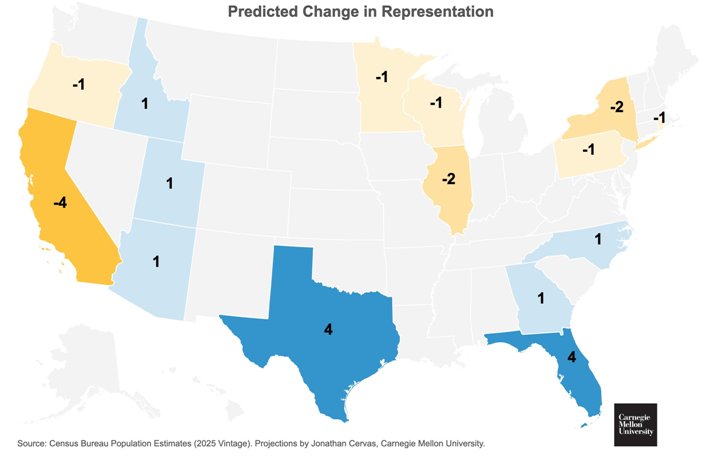
The current population trends are good news for Republicans and bad news for Democrats. Projections from redistricting expert Jonathan Cervas of Carnegie Mellon University show the following:
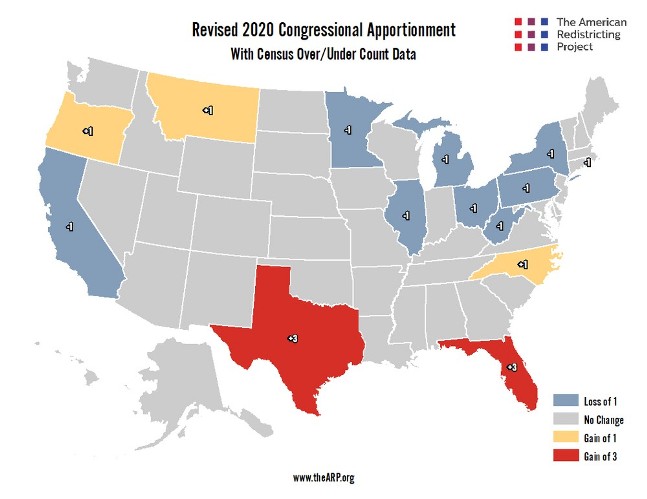
Census "errors" in 2020 Source: American Redistricting Project
We all learned in 2020 (if we weren't already aware) just how easily election results can be rigged in favor of Democrats. Another thing we learned in that same year was how easily the Census can be -- and was -- rigged in favor of Democrats as well.
"In a report compiled during President Biden's administration, the Census Bureau acknowledged that six states were undercounted in 2020 and eight were overcounted. We're just supposed to believe it was a coincidence that Mr. Biden's allies were the beneficiaries in almost every instance. Had the tally been performed honestly, Florida would have picked up two additional representatives and Texas would add another likely Republican to its delegation. On the Democrat side, Colorado retained a district it should have lost, while Minnesota and Rhode Island each profited by one seat. Overall, Democrats gained six House seats and six votes in the Electoral College." For this decade (as we have written previously): If the Democrat candidate wins every state that Democrats normally win, he/she/it will receive 226 electoral votes from California, Colorado, Connecticut, Delaware, District of Columbia, Hawaii, Illinois, Maine (3 EV out of 4), Maryland, Massachusetts, Minnesota, Nebraska (1 EV out of 5), New Hampshire, New Jersey, New Mexico, New York, Oregon, Rhode Island, Vermont, Virginia and Washington. If the GOP candidate wins every state that Republicans normally win, he will receive 235 electoral votes from Alabama, Alaska, Arkansas, Florida, Idaho, Indiana, Iowa, Kansas, Kentucky, Louisiana, Maine (1 EV out of 4), Missouri, Mississippi, Montana, Nebraska (4 EV out of 5), North Carolina, North Dakota, Ohio, Oklahoma, South Carolina, South Dakota, Tennessee, Texas, Utah, West Virginia and Wyoming. We generously count North Carolina as automatic for the GOP. But it's really a swing state that happens to do the right thing presidentially. The other swing states of Arizona, Georgia, Michigan, Nevada, Pennsylvania and Wisconsin account for 77 EV at this time, and they are the states which currently determine the overall outcome of presidential elections in the 2020s. If the 2020-2025 population trends hold up (using the Cervas model) and if the current "red" states remain that way, then the Republican presidential nominee will start off with 245 Electoral Votes out of the 270 that are needed. The six swing states will remain with 77 EV, and the Republican will require only 25 of those 77 in order to win. Remember: if this rosy scenario ever plays out, it won't affect anything until 2032. And even then, the House of Representatives may not be rosily scenario-ed as much as the hopium addicts wish -- because a shift of, say, 13 seats from "blue" states to "red" states absolutely does not mean "13 more Republicans in Congress and 13 fewer Democrats!!!" Whenever some communist state like California, Illinois or New York loses a House seat, some folks get all giddy because surely it's going to be a Democrat seat that gets erased. Perhaps it does occasionally happen that way -- but then there are all those times when that expectation turned out to be exactly wrong. If Massachusetts loses a seat, or Rhode Island (which is in fact going to lose one), then there aren't any GOP congressmen to lose and the victim has to be a Democrat. But in California, New York, etc., Democrat gerrymanderers usually have little difficulty ensuring that a Republican is the one to lose his seat. The House GOP may not reap as much of a benefit as we'd like, however the configuration of the Electoral College will improve and make it that much easier for Republicans to get to 270. Unless Texas flips, in which case none of the above matters. Tags:
2030
Census
Reapportionment
Electoral Votes
|